

(from Prārthanā)
(1)
'gaurāṅga' bolite habe pulaka-śarīra
'hari hari' bolite nayane ba' be nīra
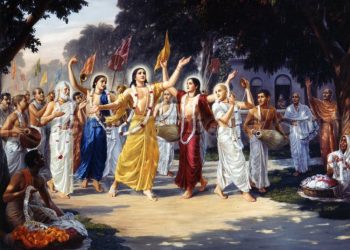
When will that opportune moment come to me when there will be shivering of the body as soon as I chant Lord Gaurāṅga's name? And after the shivering, while chanting Hare Kṛṣṇa, when will there be tears pouring down from my eyes?
(2)
āra kabe nitāi-cānder koruṇā hoibe
saṁsāra-bāsanā mora kabe tuccha ha'be
When will that day come when Lord Nityānanda's causeless mercy is bestowed upon me so that my desire for material enjoyment becomes very insignificant?
(3)
viṣaya chāriyā kabe śuddha ha 'be mana
kabe hāma herabo śrī-bṛndābana
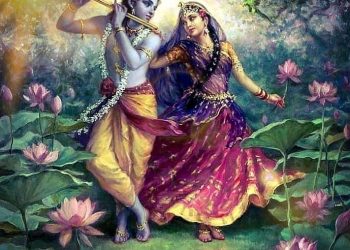
When my mind is completely purified, being freed from material anxieties and desires, then I shall be able to understand Vṛndāvana and the conjugal love of Rādha and Kṛṣṇa, and then my spiritual life will be successful.
(4)
rūpa-raghunātha-pade hoibe ākuti
kabe hāma bujhabo se jugala-pīriti
When shall I be very much eager to study the books left by the six Gosvāmīs? One has to learn of the conjugal loving affairs of Rādhā-Kṛṣṇa through the teachings of these six Gosvamīs.
(5)
rūpa-raghunātha-pade rahu mora āśa
prārthanā koroye sadā narottama-dāsa
Narottama dāsa always wishes to understand this conjugal love under the direction of the six Gosvāmīs.
Purport
His Divine Grace A.C. Bhaktivedanta Swami Prabhupāda
This song was sung by Narottama dāsa Ṭhākura, a great devotee and ācārya in the Gauḍīya Vaiṣṇava-sampradāya, the disciplic succession coming down from Lord Caitanya. Narottama dāsa Ṭhākura has written many songs, which are recognized as authoritative by all Vaiṣṇavas. He has sung these songs in simple Bengali language, but the purport—the deep meaning of his songs—is very significant.
In this song he says, 'gaurāṅga' bolite habe pulaka śarīra. One has attained the perfection of chanting when as soon as he chants the name of Lord Gaurāṅga, who initiated this saṅkīrtana movement, at once there is shivering in his body. This is not to be imitated, but Narottama dāsa Ṭhākura is asking, "When will that opportune moment come to us when there will be shivering of the body as soon as we chant Lord Gaurāṅga's name?" And after the shivering—'hari hari' bolite nayane ba 'be nīra: "While chanting Hare Kṛṣṇa, there will be tears in the eyes."
Then he says, āra kabe nitāi-cānder koruṇā hoibe. We are all asking about the mercy of Lord Nityānanda. Nityānanda is supposed to be the original spiritual master, so we have to approach Gaurāṅga, Lord Caitanya, through the mercy of Lord Nityānanda. What is the symptom of a person who has achieved the causeless mercy of Lord Nityānanda? Narottama dāsa Ṭhākura says that the symptom of one who has actually received the causeless mercy of Lord Nityānanda is that he has no more material desire. Āra kabe nitāi-cānder koruṇā hoibe saṁsāra-bāsanā mora kabe tuccha ha'be. Saṁsāra-bāsanā means "desire for material enjoyment," and Narottama dāsa wonders when it will become very insignificant. Of course, as long as we have bodies we have to accept so many material things, but not in the spirit of enjoyment, but only to keep body and soul together.
Narottama dāsa says further, rūpa-raghunātha-pade hoibe ākuti: "When shall I be very much eager to study the books left by the six Gosvāmīs?" Ākuti means "eagerness." Because Rūpa Gosvāmī is the father of devotional service, he has written a book called Bhakti-rasāmṛta-sindhu, in which there are nice directions on devotional service. These topics are also dealt with in Caitanya-caritāmṛta and other books, and we have given the summary of those directions in our book Teachings of Lord Caitanya. One has to learn of the conjugal loving affairs of Rādhā-Kṛṣṇa through the teachings of these six Gosvāmīs. Narottama dāsa Ṭhākura directs us not to try to understand the conjugal love of Rādhā-Kṛṣṇa by our own endeavor. We should try to understand this yugala-pīriti, conjugal love, under the direction of the Gosvāmīs.
As long as the mind is too much absorbed in materialistic thought, one cannot enter into the kingdom of Vṛndāvana. But Narottama dāsa Ṭhākura says, viṣaya chāriyā kabe śuddha ha'be mana kabe hāma herabo śrī-bṛndābana: "When the mind is completely purified, being freed from material anxieties and desires, then I shall be able to understand Vṛndāvana and the conjugal love of Rādhā and Kṛṣṇa, and then my spiritual life will be successful."